Searching for a cheap driving lesson near me is completely sensible. Learning to drive is a big investment, and the hourly price can quickly add up when you need regular lessons, theory test preparation, private practice and eventually a practical test.
But the cheapest lesson is not always the cheapest route to passing. A low hourly rate can become expensive if lessons are badly structured, the instructor is unreliable, or you do not get clear feedback between sessions. The real goal is to find an affordable local driving instructor who helps you improve safely, steadily and efficiently.
This guide shows you how to compare driving lesson prices without falling for false bargains, what to check before booking, and how to make your money go further.
Cheap should mean better value, not just a lower hourly rate
A good driving lesson is not just time in a car. You are paying for an instructor’s qualification, teaching ability, local road knowledge, feedback, planning and judgement about when you are ready for the test.
If one instructor charges slightly more per hour but helps you need fewer total lessons, they may be better value than the cheapest option in your area. The same applies to reliability. A lesson cancelled at short notice, a rushed 50-minute session sold as an hour, or an instructor who does not track your progress can waste both time and money.
The Driver and Vehicle Standards Agency has long suggested that many learners need around 45 hours of professional tuition plus private practice, although every learner is different. That is why small differences in lesson quality matter. Saving £3 per hour is not useful if you end up needing 10 extra lessons.
| What you compare | Cheap but risky | Better value |
|---|---|---|
| Hourly price | Lowest rate with no reviews or unclear terms | Fair local rate with strong feedback and clear lesson length |
| Instructor status | Unknown qualification | Verified ADI or PDI instructor |
| Lesson structure | Repeating the same routes without feedback | Clear goals, recap and progress tracking |
| Availability | Random gaps between lessons | Consistent weekly or twice-weekly slots |
| Test preparation | Test booked too early or too late | Instructor gives honest readiness advice |
Start with a realistic local price check
Driving lesson prices vary across the UK. London and major cities are often more expensive than smaller towns, and automatic lessons can sometimes cost more than manual because demand is high and there may be fewer instructors available.
Before choosing, compare at least three local instructors by postcode. Do not judge on the headline hourly rate alone. Check what is included, how long the lesson actually lasts, whether pickup is flexible, and whether the instructor has availability that matches your schedule.
Common factors that affect the price include:
- Location: Busy areas with high demand and long test waiting times often have higher lesson rates.
- Manual or automatic: Automatic lessons may cost more per hour, but some learners need fewer lessons because there is no clutch control to master.
- Lesson length: A 90-minute or two-hour lesson can offer better value if you spend less time recapping and more time practising.
- Instructor experience: A highly rated ADI may charge more, but strong teaching can reduce wasted lessons.
- Time of day: Evening and weekend slots may be harder to find, especially around school, college and work schedules.
For a deeper breakdown of current prices, see our UK driving lesson costs guide.
Check the instructor’s qualification before looking at discounts
In the UK, professional driving instructors should be either an Approved Driving Instructor, known as an ADI, or a Potential Driving Instructor, known as a PDI. ADIs display a green badge, while PDIs display a pink badge.
A PDI can still be a good option, and may sometimes offer competitive pricing while completing their training. The key is transparency. You should know who is teaching you, what their status is and what support or supervision they have.
You can use the official GOV.UK service to find driving schools and lessons, and platforms like My Driving Instructor help learners compare verified ADI and PDI instructors locally.
Before booking, ask simple questions:
- Are you an ADI or PDI? A good instructor should answer clearly and be happy to explain.
- How long is each lesson? Confirm whether it is 60, 90 or 120 minutes.
- Do you offer pickup and drop-off? Flexible pickup from home, work, college or school can save travel time.
- How do you track progress? You want more than verbal reassurance that you are doing fine.
- What is your cancellation policy? Cheap lessons can become expensive if terms are unclear.
Look for signs that lessons will be efficient
A worthwhile cheap driving lesson should have structure. You should know what you are working on, why it matters and what you need to practise next.
When reading reviews, look beyond generic praise like “great instructor”. The most useful reviews mention patience, punctuality, calm explanations, confidence-building, local test route knowledge and honest feedback. If several learners say they improved quickly or felt less nervous, that is a positive sign.
Good lessons usually include a short recap, a clear focus for the session, targeted practice, feedback at the end and a plan for next time. This matters because learners often lose money when lessons feel random. You might drive around for an hour, but if there is no goal, it is hard to measure progress.
If you are unsure what a strong instructor should offer, read our guide on how to choose a driving instructor.

Ways to reduce driving lesson costs without lowering quality
Once you have found a reliable instructor, there are sensible ways to make lessons more affordable. The aim is not to cut corners, but to reduce wasted time.
| Money-saving tactic | Why it can help | What to watch |
|---|---|---|
| Book regular weekly lessons | Keeps skills fresh and reduces recap time | Long gaps can slow progress |
| Try 90-minute lessons | Gives more time for varied routes and manoeuvres | Only useful if you can stay focused |
| Ask about block bookings | Some instructors offer a lower rate for upfront packages | Avoid large blocks before trying one lesson |
| Practise privately if possible | Builds confidence between professional lessons | You need the right insurance, supervision and L plates |
| Be flexible with times | Off-peak slots may be easier to book | Do not choose times when you are tired or rushed |
| Prepare before each lesson | Saves lesson time on repeated explanations | Use notes, theory revision and instructor feedback |
Private practice can be especially valuable if you have access to a suitable car and a qualified supervising driver. It should support professional lessons, not replace them. Your instructor can tell you what to practise, such as moving off smoothly, mirror routines, steering accuracy or parking observation.
If you are trying to estimate your total budget, our guide on how many driving lessons you may need can help you plan realistically.
Be careful with block booking deals
Block bookings can be a smart way to save money, but only after you know the instructor is right for you. Paying for 10 or 20 hours upfront with someone you have never met is risky.
A safer approach is to book one lesson first. Treat it as a trial. If the instructor is punctual, calm, organised and clear about your progress, then ask about package prices.
Before paying for a block, confirm:
- Refund terms: Ask what happens if you move area, change instructor or stop learning.
- Expiry dates: Some packages must be used within a set time.
- Lesson duration: Make sure the package is based on full hours, not vague sessions.
- Availability: A discount is not helpful if you can only get one lesson every three weeks.
- Payment method: Keep a record of what you paid and what was agreed.
Good instructors are usually clear about their terms. Pressure to pay immediately, vague pricing or refusal to explain cancellation rules are warning signs.
Watch out for false bargains
Some cheap lessons cost more in the long run because they slow your progress or damage your confidence. Trust your instincts if something feels off.
Red flags include an instructor who regularly cancels, spends lesson time on their phone, shouts, avoids explaining mistakes, gives no feedback, changes prices without warning or pushes you towards a test before you feel safe.
Price transparency matters in any transport-related booking. For example, when comparing services such as electric voiturette hire with clear daily rates and conditions, you would check licence rules, age requirements, deposits and booking terms before paying. Apply the same mindset to driving lessons. Know exactly what you are getting before you hand over money.
A cheap lesson is only worth it if it is safe, professional and consistent.
Use your first lesson as a value test
Your first lesson is not just about getting behind the wheel. It is also your chance to judge whether the instructor is worth your time and budget.
After the lesson, ask yourself whether you felt respected, whether the instructor explained things clearly and whether you know what you need to work on next. You do not have to feel perfect after one session, but you should feel that the lesson had a purpose.
| First-lesson check | Good sign | Warning sign |
|---|---|---|
| Punctuality | Arrives on time and gives the agreed lesson length | Late arrival with no explanation |
| Communication | Calm, clear and patient | Shouting, sarcasm or unclear instructions |
| Structure | Sets goals and reviews progress | Random driving with no feedback |
| Safety | Takes control calmly when needed | Makes you feel unsafe or rushed |
| Planning | Explains next steps | No idea what you will do next lesson |
If the fit is wrong, it is better to switch early than to keep paying for lessons that do not suit you. The best instructor for your friend may not be the best instructor for you.
Compare local instructors in one place
Searching online, messaging instructors individually and trying to remember prices can get frustrating. This is where My Driving Instructor can make the process easier.
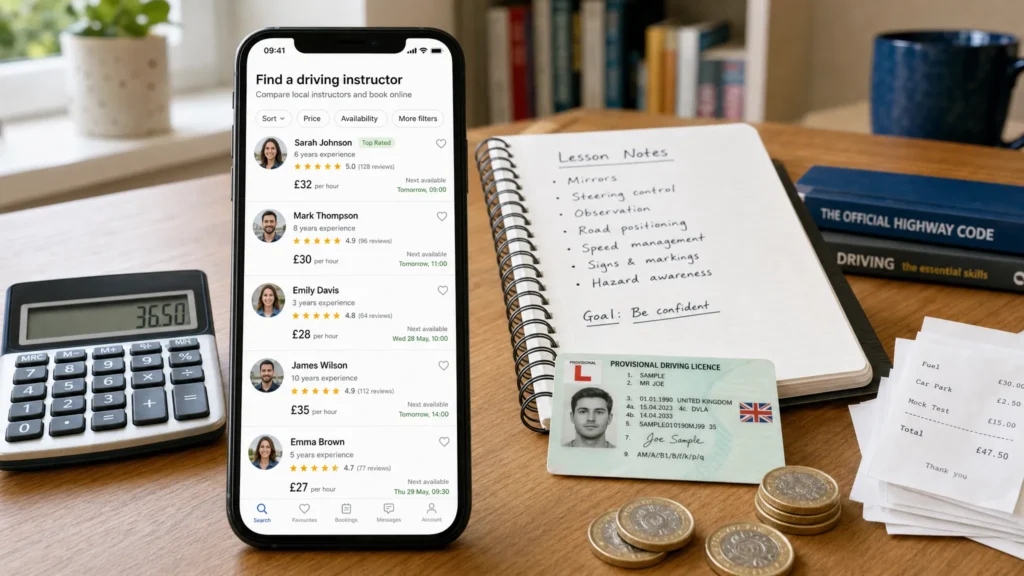
My Driving Instructor is a free app that connects learner drivers with verified driving instructors across the UK. You can search by postcode, compare instructors, read reviews and book lessons in-app. Learners can also benefit from lesson progress tracking and flexible pickup locations, while instructors can manage bookings and build their reputation.
That makes it easier to compare value, not just price. Instead of choosing the first cheap lesson you find, you can look at qualification status, reviews, availability and practical details together.
Should you choose manual or automatic to save money?
This depends on your goals. Manual lessons may be cheaper or easier to find in some areas, and passing in a manual gives you a licence to drive both manual and automatic cars. Automatic lessons can sometimes cost more per hour, but some learners progress faster because there is less to coordinate.
If your main aim is to pass confidently and you expect to drive automatic cars afterwards, automatic could be better value. If you want maximum flexibility for future cars, jobs or rentals, manual may be worth the extra learning time.
The important thing is not to choose purely on hourly price. Choose the route that fits your confidence, future driving needs and total budget. Our automatic vs manual guide explains the trade-offs in more detail.
Frequently Asked Questions
Is the cheapest driving lesson near me usually the best option? Not always. The cheapest hourly rate can be poor value if the instructor is unreliable, lessons lack structure or you need more hours overall. Look for a fair price, verified qualifications, strong reviews and clear progress tracking.
How can I find affordable driving lessons near me? Compare instructors by postcode, check reviews, confirm lesson length, ask about block bookings and look for flexible pickup options. My Driving Instructor lets you search and compare verified local instructors in one place.
Should I book a block of cheap driving lessons? Only after you have tried at least one lesson. A block booking can save money, but you should first check that the instructor’s teaching style, availability and communication suit you.
Are PDI driving instructors worth considering? Yes, a PDI can be a good option if they are transparent about their status and you feel comfortable with their teaching. Some PDIs may offer competitive rates while gaining experience.
Can private practice reduce the number of paid lessons I need? It can help, provided you have the right supervision, insurance, L plates and a suitable car. Private practice works best when your instructor gives you specific skills to practise between lessons.
Is it better to take one-hour or two-hour lessons? Many learners benefit from 90-minute or two-hour lessons because there is more time to practise varied roads and manoeuvres. However, shorter lessons may suit beginners who tire quickly. Choose the format that helps you stay focused.
Find a lesson that fits your budget and helps you progress
A cheap driving lesson is worth it when it helps you become a safer, more confident driver without wasting time. Compare the full picture: qualification, reviews, lesson structure, availability, pickup options and progress tracking.
With My Driving Instructor, you can search by postcode, compare verified ADI and PDI instructors, read reviews and book lessons through a free app built for UK learners. Start with one lesson, judge the value, and build from there.
Key Takeaways
- Research your options and compare different instructors before booking
- Consider your learning style and choose manual or automatic accordingly
- Budget for the full journey including test fees and practice time
- Stay consistent with lessons to retain skills between sessions