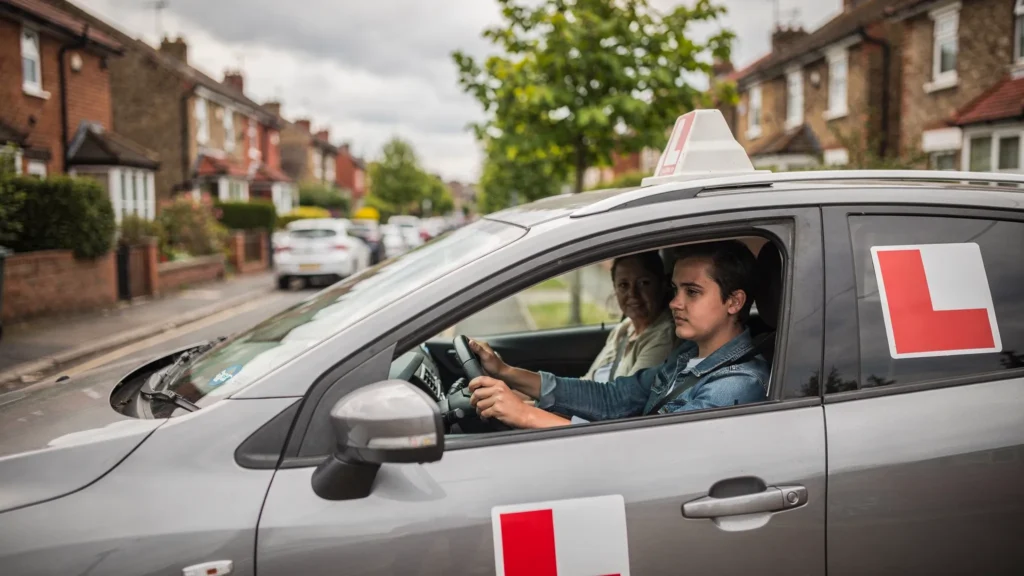
Yes, you can drive UK roads as a new learner, but only if you follow the learner driver rules. In simple terms, you need a valid provisional licence, proper supervision, suitable insurance, visible learner plates and a roadworthy vehicle.
You cannot drive alone on a provisional licence, even for a short journey. You also need to know the difference between ordinary roads, dual carriageways and motorways, because the motorway rules for learners are more limited.
This guide focuses mainly on car learners in Great Britain, meaning England, Scotland and Wales. Northern Ireland has separate driver licensing rules in some areas, so learners there should also check nidirect learner driver guidance.
Quick answer: what new learners can and cannot do
| Question | Short answer |
|---|---|
| Can you drive before passing your theory test? | Yes, if you have a valid provisional licence and meet all learner rules. |
| Can you drive alone as a learner? | No. You must be properly supervised at all times. |
| Can you drive with a parent or friend? | Yes, if they meet the legal supervisor requirements and you are insured. |
| Can you drive on motorways? | In Great Britain, only with an approved driving instructor in a dual-control car. |
| Can you drive at night? | Yes, if supervised and insured, although beginners should build up gradually. |
| Can you practise in your own car? | Yes, if the car is legal, insured for you as a learner and displays L plates. |
| Can you drive in Wales with D plates? | Yes. In Wales, you can use D plates instead of L plates. |
What you need before you drive on UK roads
Before you take control of a car on a public road, make sure every legal requirement is covered. Missing just one requirement can lead to fines, penalty points, invalid insurance and a much more stressful start to learning.
A valid provisional driving licence
Most learner drivers can start driving a car on public roads from age 17. You can apply for your first provisional licence earlier, but you cannot drive a car on the road until you are legally old enough and your licence is valid. GOV.UK explains the application process on its provisional driving licence page.
You do not need to pass your theory test before starting driving lessons or private practice. The theory test is required before you can book your practical driving test, not before you can begin learning.
You must also meet the eyesight requirement. As a learner, you need to be able to read a standard number plate from the required distance. Your instructor will usually check this at the start of your first lesson, but it is your responsibility to make sure your eyesight is safe for driving.
The right supervision
If you are learning with a professional instructor, they must be qualified to teach. In the UK, this usually means an approved driving instructor, known as an ADI, or a trainee driving instructor, known as a PDI, displaying the correct badge in the car.
If you practise with a parent, friend or relative, they must meet the legal rules for supervising a learner. GOV.UK states that they must be at least 21, be qualified to drive the type of vehicle you are learning in, and have held a full driving licence for at least 3 years. You can read more in the official guidance on practising with family or friends.
Your supervisor should act as if they are responsible for the journey, because in practice they are there to keep you, your passengers and other road users safe. They should be alert, sober, calm and ready to help. They should not use a mobile phone while supervising.
Proper learner driver insurance
If you have lessons in your instructor’s car, their business insurance will normally cover learners, but it is still sensible to confirm this if you are unsure.
If you practise in your own car or a family member’s car, you need insurance that specifically covers you as a learner driver. Do not assume that the car’s main policy automatically covers you. Insurance in the UK is not simply attached to the vehicle in a way that lets anyone drive it.
Learner driver insurance can be arranged as a temporary policy, a named driver addition or a specialist learner policy. The right option depends on the car, how often you will practise and the insurer’s terms.
L plates or D plates
Learner drivers must display L plates on the front and back of the vehicle. They need to be clearly visible to other road users, not hidden in a window corner, covered by dirt or angled so they are hard to see.
In Wales, learners can display D plates instead of L plates. The D stands for dysgwr, the Welsh word for learner. L plates are also accepted in Wales.
If the car is not being driven by a learner, L plates should usually be removed or covered, unless it is a driving school vehicle where this may not be practical between lessons.
A legal and roadworthy vehicle
The car must be safe and legal. That means it needs valid tax, a valid MOT if required, working lights, legal tyres, functioning mirrors and no dangerous defects. If you are practising in a family car, check the basics before setting off.
A learner driver can still be held responsible for offences committed while driving. If the tyres are illegal, the vehicle is uninsured or you drive without proper supervision, it is not just the car owner who may face consequences.
Which UK roads can a learner drive on?
In Great Britain, learner drivers can use most public roads as long as they meet the legal conditions. This includes quiet residential roads, town roads, rural roads, main roads and dual carriageways.
The key is not just whether you are legally allowed, but whether the road is suitable for your current skill level. A brand-new learner should not start on a busy multi-lane roundabout or a fast rural A-road. A good instructor will build your confidence step by step, moving from quiet roads to more complex traffic situations when you are ready.
Speed limits apply to learner drivers in the same way as other drivers in Great Britain. A limit is not a target. If conditions are poor, visibility is reduced or you are approaching hazards, you must adjust your speed safely.
Northern Ireland has different learner driver rules, including speed restrictions, so learners there should check current guidance on nidirect before practising.
Can learner drivers go on motorways?
In Great Britain, learner drivers can drive on motorways, but only in a very specific situation: you must be with an approved driving instructor and the car must be fitted with dual controls.
This means you cannot practise on a motorway with a parent, friend or relative, even if they are a qualified supervisor. You also cannot take your own car onto the motorway as a learner unless it is a dual-control car being used with an approved driving instructor.
Motorway lessons are not compulsory, but they can be useful once you have good control, lane discipline and confidence at higher speeds. The rule was introduced to help learners gain safer motorway experience before passing, rather than facing motorways for the first time alone after getting a full licence. GOV.UK has published guidance on learner drivers on motorways.
Your practical driving test will not take place on a motorway, but it may include faster roads such as dual carriageways, depending on the test centre and local routes.
Can you practise in car parks or on private land?
Private land can seem like an easy place to practise, but you need to be careful. If the public has access to the area, such as a supermarket car park, retail park or public car park, road traffic laws may still apply.
If you are using genuinely private land, you need the landowner’s permission. You should also treat it as a controlled practice area, not a place to take risks. Cones, empty spaces and slow-speed control exercises can be helpful, but they are not a replacement for structured lessons on real roads.
A sensible learning order for new drivers
The safest way to drive UK roads as a new learner is to progress gradually. Legal permission does not mean every road is a good idea on day one.
| Learning stage | Best practice environment | Skills to build |
|---|---|---|
| First sessions | Quiet roads or controlled areas | Moving off, stopping, steering, clutch control or brake control |
| Early road practice | Calm residential streets | Mirrors, signals, junctions, meeting traffic and speed control |
| Developing confidence | Busier local roads | Roundabouts, lane positioning, pedestrian crossings and traffic lights |
| Test preparation | Mixed road types near your test area | Independent driving, judgement, manoeuvres and hazard awareness |
| Advanced confidence | Dual carriageways and, with an ADI, motorways | Higher-speed planning, lane discipline and safe following distances |
If you are using private practice alongside lessons, ask your instructor what to practise. This helps avoid picking up bad habits or attempting roads that are too difficult too soon.
Common mistakes new learners should avoid
One of the biggest mistakes is thinking that a short drive without supervision does not count. It does. Driving alone as a learner is illegal and can put your insurance, licence and safety at serious risk.
Another common mistake is assuming that a parent can supervise simply because they are an experienced driver. They must meet the legal requirements, and they must be qualified to drive the type of car you are using. For example, someone with an automatic-only licence is not qualified to supervise you in a manual car.
Insurance errors are also common. If you are not named on the policy or covered by a suitable learner policy, you may be driving uninsured. That can lead to severe penalties and can make it harder or more expensive to get insurance later.
Learners also sometimes use poor-quality L plates that fall off, fold over or become hard to see in bad weather. Magnetic plates are convenient, but they must stay secure. If your car has plastic or aluminium panels where magnets do not attach well, use an alternative that remains visible and legal.
Should you start with an instructor or private practice?
Private practice can be very valuable, but most new learners benefit from starting with a professional instructor. A good instructor can explain the controls clearly, introduce roads in the right order and spot problems before they become habits.
Professional lessons are also helpful because instructors understand local test expectations, common learner errors and how to structure progress. If you are nervous about starting, read our guide to what to expect on your first driving lesson.
Once you have the basics, private practice can help you gain experience between lessons. It is especially useful for improving judgement, road positioning, observation and confidence in everyday traffic. For a broader view of lesson planning, see our guide on how many driving lessons you may need.
If you are still choosing between instructors, it is worth comparing qualifications, reviews, availability, teaching style and whether they offer manual or automatic lessons. Our guide on how to choose a driving instructor explains what to look for.
Frequently Asked Questions
Can I drive on UK roads before passing my theory test? Yes. You can take lessons and practise on public roads before passing your theory test, as long as you have a valid provisional licence, proper supervision, insurance and L plates.
Can I drive alone on a provisional licence? No. A learner driver must be supervised at all times. Driving alone on a provisional licence is illegal and can lead to penalty points, fines and insurance problems.
Can my parent teach me to drive? Yes, if they are at least 21, qualified to drive the vehicle type and have held a full driving licence for at least 3 years. You must also be properly insured as a learner.
Can a learner drive on a motorway in the UK? In England, Scotland and Wales, learners can drive on motorways only with an approved driving instructor in a dual-control car. Private motorway practice with family or friends is not allowed. Northern Ireland rules differ, so check nidirect.
Do I need L plates on every lesson? Yes. Learner vehicles must display clear L plates at the front and rear. In Wales, D plates may be used instead.
Can I drive my own car as a learner? Yes, provided the car is roadworthy, taxed, MOT’d if required, insured for you as a learner and fitted with visible L plates. You must also have a suitable supervisor in the car.
Can learner drivers carry passengers? In Great Britain, there is no general rule banning learners from carrying passengers, but your insurance must allow it and your supervisor should decide whether it is sensible. For early lessons, fewer distractions are usually better.
Can learners drive at night or in bad weather? Yes, if all learner rules are met. However, night driving and poor weather require extra judgement, so build up to them with an instructor or experienced supervisor.
Start driving with the right support
Learning to drive is exciting, but the rules matter. With the right licence, supervision, insurance and instructor support, you can build confidence on UK roads safely and legally.
My Driving Instructor helps learners find verified ADI and PDI instructors across the UK. You can search by postcode, compare reviews and ratings, book lessons, track progress and arrange flexible pickup locations in one free app.
If you are ready to start learning, find a qualified instructor near you and take your first step towards passing with confidence.
Key Takeaways
- Research your options and compare different instructors before booking
- Consider your learning style and choose manual or automatic accordingly
- Budget for the full journey including test fees and practice time
- Stay consistent with lessons to retain skills between sessions